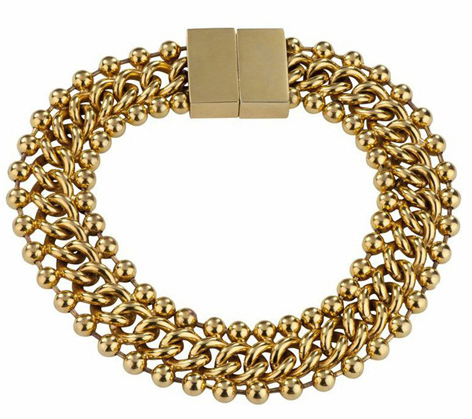
The V&A has one of the finest and most comprehensive collections of jewellery in the world. Over 3,000 jewels tell the story of jewellery in Europe from ancient times to the present day; from jewels by Cartier to animals by Fabergé.
Jewellery is a universal form of adornment. Jewellery made from shells, stone and bones survives from prehistoric times. It is likely that from an early date it was worn as a protection from the dangers of life or as a mark of status or rank.
In the ancient world the discovery of how to work metals was an important stage in the development of the art of jewellery. Over time, metalworking techniques became more sophisticated and decoration more intricate. Here we take a look at some of our favourite and most inspirational pieces.
Collar known as The Shannongrove Gorget, maker unknown, Ireland, late Bronze Age (probably 800-700 BC)
Gold, a rare and highly valued material, was buried with the dead so as to accompany its owner into the afterlife. Much archaeological jewellery comes from tombs and hoards. Sometimes, as with the gold collars from Celtic Ireland which have been found folded in half, it appears people may have followed a ritual for the disposal of jewellery.
Brooch, Unknown maker, France (probably), About 1400
Pendant, Georges van der Straeten,1901, Paris, Gold, diamonds
The jewellery worn in medieval Europe reflected an intensely hierarchical and status-conscious society. Royalty and the nobility wore gold, silver and precious gems. Humbler ranks wore base metals, such as copper or pewter. Colour (provided by precious gems and enamel) and protective power were highly valued.
Collar, Castellani,1870, Italy, Woven gold band, with a fringe of hollow gold pendants
The archaeological discoveries of the 19th century led to a greater awareness and understanding of ancient jewellery. For the first time these intricate gold pieces were collected, studied and published, and both the originals and the published illustrations of them were a rich new source for designers of jewellery. The resulting 'archaeological-style' jewellery was fashionable from around 1860 until at least the 1880s.
Neckpiece, Marjorie Schick, 1995, USA, Painted papier-mâché, additional metal supports
Since the 1960s the boundaries of jewellery have been continually redefined. Conventions have been challenged by successive generations of independent jewellers, often educated at art college and immersed in radical ideas.
New technologies and non-precious materials, including plastics, paper and textiles, have overturned the notions of status traditionally implicit in jewellery.
Avant-garde artist-jewellers have explored the interaction of jewellery with the body, pushing the boundaries of scale and wearability to the limits. Jewellery has developed into wearable art. The debate on its relationship to Fine Art continues.